| A
Letter from the Owner Vince Naeve -
People
have been commenting about some chatter being posted on the
web. A long time friend and customer has recently made me
aware of this. As usual, in this world of sound bytes and
quick words taken out of context, I feel people have read
me incorrectly, or more over, have not understood a deeper
realization about the recording or Hi-Fi industry and the
equipment they transact.
To preface the whole matter, I should tell you that I have
been doing electronics since I was a teenager. I worked for
many audio companies such as H. H. Scott, KLH, APT Corp. and
other electronic shops as service manager, chief technician,
and assistant to engineer, as well as writing product reviews.
I have met and sat and learned with many of the great entrepreneurs
and engineers, mostly from the 1960’s, 1970’s, and 1980’s.
The lessons I have learned and information garnered from countless
technical books and magazine articles (I have an extensive
personal library from the 1920's to the 1990's) over the past
30 years is the basis for my opinions. What I try to explain
to people is often past their understanding. I think I do
a good job of translating concepts of technology into what
we think we hear or how we use or misuse our electronic technology.
I can say bluntly that I seldom have any trouble conversing
with technically educated people but have been frustrated
to inform people who are already convinced about the mythic
ideas that prevail in the audio industry.
I will admit that my biggest display of arrogance is directed
at fancy, very expensive audio equipment, whether it is Hi-Fi
or studio equipment, which doesn’t perform any better than
something inexpensive. It is difficult to go into details
presently, but it should be made clear that way too many consumers
and manufacturers make claims about the sound quality of their
equipment, when in fact I see and test and hear only an aluminum
box of op-amps and connectors which in my opinion seem to
be just like anyone else’s. Sure, certain manufacturers paint
the front panel some outrageous color, or put fancy knobs
on and change the gain structure of some amplifier stage,
creating an audio level difference, therefore, making it easy
to mislead most people when they try to do their personal
comparisons of products (honestly, many engineers that I have
talked to agree with me on this matter). I have tried
to explain many times to many people that certain sound characteristics
(i.e. warm, driven, fat, clean, bright) can sometimes be obtained
in a $100 box as easily as a $1000 box. Some people won’t
give me a little credit for spending 30 years in this business
and being able to recognize this deception. I’ve taken apart,
serviced, modified, and corrected design flaws of thousands
of units. Manufacturers, way too often, have made products
with horrible design flaws (which often result in sound quality
flaws or enhancements depending on your perceptual need).
These flaws can come in your $100 box or your $1000 box.
I know I have satisfied many people and have solved problems
that others cannot, including the manufacturers. And trust
me on this one; manufacturers usually don’t care about fixing
their errors. They know it is costly to recall a unit and,
more over, if the fault is simply not recognized by the consumer,
they won’t be concerned. By and large, with 3000 people a
year coming through this shop, and giving successful service,
advice, and sales, I feel a few people who have not felt satisfied
is typical for any business. A point to be made, by the way,
is that I am overworked, understaffed, and underfed. I dare
you to go find a service shop which can give information about
vintage synths, calibrate a 30 year old reel to reel, or fix
a digital delay line that the manufacturer can’t. What I can’t
do is feel comfortable patronizing people for their mistaken
beliefs about electronics. They need to go to the local chain
marketing store, let a salesperson pat them on the back, and
pander the best price profit margin item that they have in
stock.
If you want a guy in a business suit to help you analyze the
market, that’s one thing. If you want someone to crawl under
your car for you, see an auto mechanic.
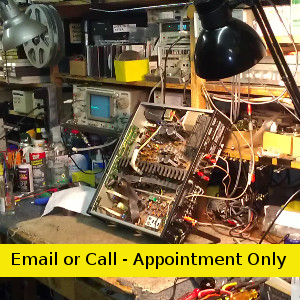
If I may now continue my rant, my technicians and I need to
work under 200+ watts of lighting on the benches all day long.
This is due to requirements to fix much of this sophisticated
miniature or complex circuitry which is prevalent in electronics
today.
Do this 8-10 hours, day in and day out, and you get a little
anxious. Not too many tech types hold up in the long run.
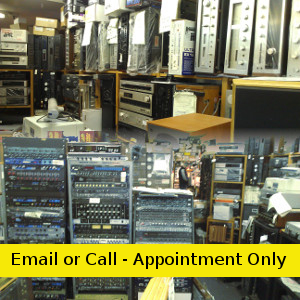
We barely have enough time to keep our shops clean and presentable
to sell some thousand dollar 1 channel mic preamp to a customer
who will judge me from a single appearance flaw in my shop.
I know I am trading that one customer to solve problems for
ten other people. That’s business.
I obviously wear my heart and my business on my sleeve. It
is very obvious to people that I don’t hide what I do or who
I am. My shop is an open book. Fortunately, most people are
willing to turn the page and read on, become informed, and
reduce their risk of purchasing overpriced, inappropriate,
or troublesome equipment. Unreasonable purchases of electronics
are one reason why so much equipment is on the used market
or in the dump. We also have to tolerate the bad luck scenario
of getting good equipment that breaks, as any electro-mechanical
device can develop problems. Hopefully, a technical person
will be there to help.
I would also like to put another matter in perspective. I
have been criticized for recommending to “buy the cheapest
product.” I often do this because people want something cheap
and I will recommend the least expensive thing that still
functions as well as the competition. It doesn’t make me a
lot of money but, honestly, I see things for small dough do
as well as expensive stuff. If a customer is on a budget,
I have to admit that I don’t sucker them into buying expensive
equipment when they still have to put food on the table or
afford to buy tape to record onto. I see a lot of broke musicians
who can’t get a dime or a dollar when they go to sell their
equipment. I have had a history of buying or trading in recommended
items at 50% or better of what they paid for them. This allows
my customers to swap and try more equipment. Many come to
the conclusion that I make pretty good judgment calls on equipment.
More importantly, most of what I sell can be serviced or modified
in the future.
I admit that there is a more esoteric market for high priced
equipment, some of which is very well done and will retain
some value as it ages. I will transact in this realm if the
customer insists and is comfortable with its performance.
But, too often, the need to buy fancy stuff is more ego driven
than real need. I know most serious studios must have the
big names in their racks, and I recommend it because they
need to “sell” their studio time and respect their client’s
desires. More over, many engineers have a passionate familiarity
of operation of certain types of recording studio gear. Without
a doubt, there are distinctly clever or specially designed
equipment which has its value and functional use, yet have
no other equipment like it. We all have to pay for something
exceptional.
That’s fair, but when people adamantly insist that some basic,
mediocre device can be the only thing that will sound a certain
way, I get arrogant. I have had two studios in my home for
twenty years; one is a synth studio, the other a grand piano,
guitar, acoustic studio. I have auditioned countless devices
(mics, preamps, reverb, compression, etc.) in there. I’ve
come to the conclusion that it is the engineer and his appropriate
use of mics and mixing of the audio which defines the finished
quality of the music, performance, and cost.
It should be obvious to most engineers and musicians that
the availability of incredible quality equipment for a fraction
of the cost five, ten, or twenty years ago is now driving
the home and semi-pro market. Personally, I’ve heard better
finished CD’s come out of an 8 track (analog or digital) amateur
studio than I’ve heard from professional releases. Don’t tell
me you will argue with that. I know way too many talented
musicians who have done most of their own recording and come
out with very deep and provocative and artistic performances
on record. That is what ultimately counts. I feel I recommend
equipment that is easy and flexible to use and will allow
a studio/engineer/musicians to get it recorded without ridiculous
expense or fiddling. I have heard too many stories of studios
taking a day to set up just one mic for a particular take.
Well, OK, but maybe you just simply got the wrong $1000 piece
of gear for the job; maybe the $100 thing will do it better
in less time and, of course, vice versa. I also rent to my
customers some of the fancy stuff, so they can give it a try.
Usually, once I have explained some clever recording tips,
they realize what will work best. You would be surprised how
often the “cheap stuff” will appear to be just as effective.
I have to admit I own mostly cheap reverbs and keyboards and
processors. But, and here is a big exception, seldom can you
cheap out on a quality instrument. Good pianos, cellos, acoustic
guitars, flutes, etc. don’t come cheap. The quality of most
acoustic devices is reflected in their price. A tip comes
to mind. When it seems you just can’t get the piano to record
well, try getting another retuning done. Although I tune my
own piano, I have realized there are special piano tuners
who know how to voice and stretch the tuning to suit a particular
piano. Same goes with setting intonation on guitars and other
instruments. In my opinion, musicians and their favored instrument
will create more magic than buying a fancier processor. Find
your true voice and even a modest quality recording will reflect
your intentions.
I have one final comment, perhaps why I get annoyed at fancy
equipment and prices. It’s not that I am trying to spoil everyone’s
fun, but more importantly I feel the manufacturers have missed
the mark by not making audio devices which are truly different,
flexible, and novel. Only recently have manufacturers started
making layered reverb algorithms or mic preamps with variable
impedance matching.
Keep
in tune, there is more to be said....... |